2 min. read
PHP2Shell Incident, What Should I Do
An overview of the recent critical PHP vulnerabilities, Passbolt's response, and steps self-hosted users should take.

Passbolt team
22 October, 2026
7 min. read

Two or three years ago, a major software supply chain attack was unusual, an event that occurred once every couple of years and grabbed headlines not just in specialized cybersecurity newsletters but in the mainstream media as well. But since the beginning of 2026 there's been a supply chain attack nearly every other day, and vulnerability reports are flooding the ecosystem. Cybersecurity companies aren’t the only ones impacted: Ideally, all software companies take security seriously, and are therefore equally concerned about vulnerability reports and supply chain attacks.
But the stakes are higher for companies like Passbolt whose software handles secrets. “We are selling trust,” explained Remy Bertot, Passbolt’s CTO. “We need to be capable of defending ourselves correctly.”
In talking about how AI, in particular generative AI, has impacted cybersecurity, there are two angles. First of all, we have to consider how AI has changed the general security environment in software engineering, including who is capable of pulling off complex attacks and how easy it is to discover and exploit vulnerabilities. The second question is around what happens inside software engineering teams, how the strategies for defense against cyber attacks are changing, and what role generative AI has in those defenses.
If the water everyone swims in has changed, what should security-conscious software companies do to ensure they’re able to maintain an acceptably strong security posture, and protect both themselves and their customers? And how do you find the right balance between speed and security in an environment that’s obsessed with productivity?
The core cybersecurity challenge in the age of generative AI is that LLMs are very good at finding vulnerabilities, but they are not that good at fixing them or at defense in general. “LLMs are non-deterministic, so it works well for offense because you only need it to work once.” Bertot said. “For defense you need to make it work every time. So it needs to be deterministic.”
In practice, this means that the barriers to entry for mounting a cyber attack, or even just discovering a vulnerability, have dropped dramatically, both in terms of the skills required on the part of the attackers as well as in the amount of time and resources necessary to prepare an exploit. But fixing vulnerabilities still happens at a human pace.
Even if you use generative AI to create the patch, it still needs to go through a rigorous review process and have at least four eyes verifying that there aren’t any mistakes. This asymmetry is what makes the current cybersecurity environment so hard to navigate.
“For patching, it’s not very useful,” said Gaetan Devaux, Lead Website Engineer, about Claude Code. “For example, we can use AI to do an evaluation of whether overwriting at the root of the project ourselves will break the functionality of the sub-dependencies that are used by our dependency. But we can’t just put in the CVE number and tell Claude okay, fix it.”
Of course, there are hundreds of startups out there promising that you can just plug their AI into your defense system, and it will work. Bertot isn’t convinced. “You still need to do normal software engineering, like alerting and countermeasures,” he said. “Maybe LLMs can help you analyze a lot of data and summarize it for you, and that will help you make decisions faster, because you’re dealing with a large volume of data. That might be a good use case for LLMs.” But since it’s not deterministic, would you really want it in the driver’s seat?
For companies like Passbolt that take security seriously, the need to thoroughly review code before any new features ship has always slowed down feature delivery to a certain extent. The current environment is a double whammy when it comes to productivity compared to less security focused companies. First of all, the flood of security vulnerabilities means that much more time is spent working on the fixes compared to developing new features. At the same time, Passbolt engineers have the same review processes on new code as before, so the productivity increases from AI on new feature development aren’t that big.
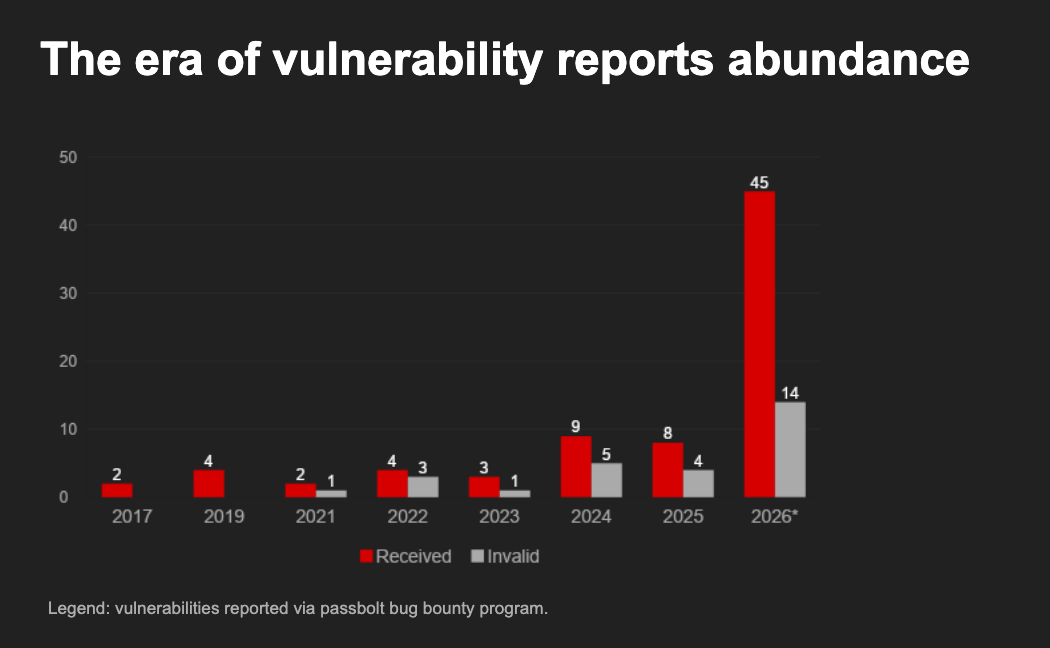
When it comes to the security vulnerabilities, though, there’s some hope of a light at the end of the tunnel. At some point, if you fix all the security issues, you should get to a point where you’ve fixed everything. “At some point, it will go down,” said Stéphane Loegel, Product Software Engineer, about the number of security issues he’s dealing with. But that certainly hasn’t happened yet, and the process is painful. “We had a period where we were, maybe not paralyzed, but the team I was working with had to slow down a lot because there were a lot of things to review.”
Passbolt already had a tight security posture, but the flood of AI-related vulnerabilities has forced the team to tighten the security posture even further. First of all, they’ve reduced the attack surface by aggressively reducing the number of dependencies, which means there are fewer places that vulnerabilities could pop up and a lower risk of a supply chain attack. Being frugal about dependencies has always been part of Passbolt’s security strategy, but it’s something they are even more aggressive about now.
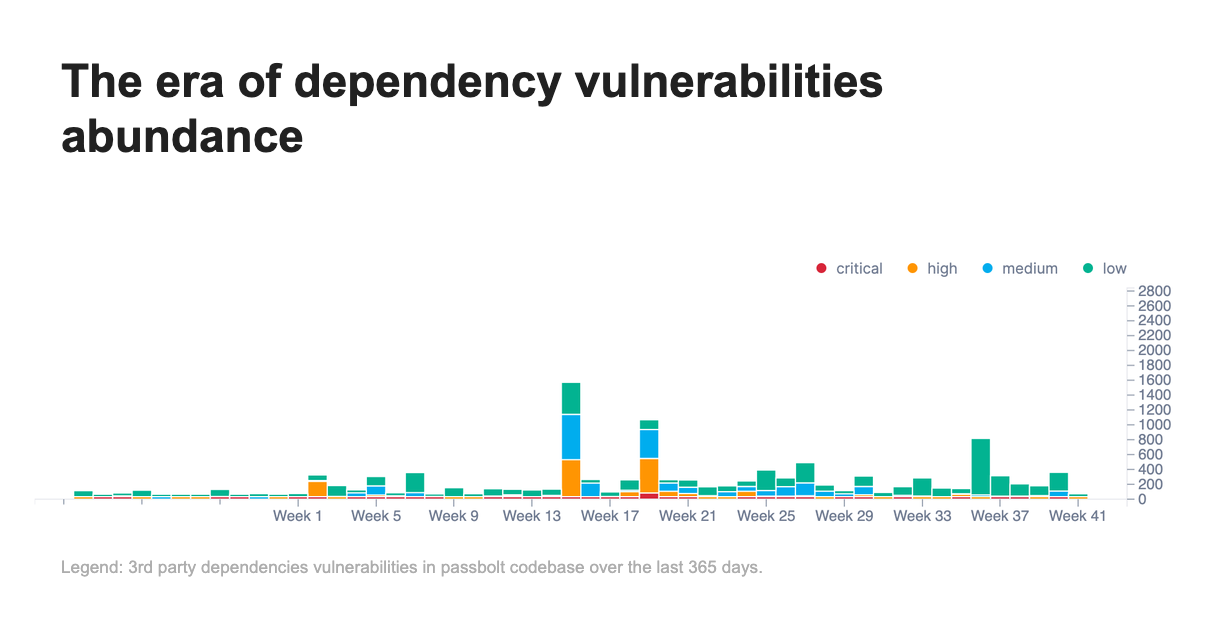
The team is also more aggressive about proactively scanning for vulnerabilities inside the dependencies that can’t be eliminated, so that they proactively fix them. This, incidentally, is a situation where AI is useful — the team is able to make use of generative AI’s strength in finding vulnerabilities and fixing them before the code is pushed to production.
“If you use AI in this way, normally what is delivered in the end is safer as well,” Loegel said. There are trade-offs, though. Because AI only helps you discover the weaknesses but not fix them, the team has the same problem of a flood of security vulnerabilities that have to be fixed by a human. “It’s painful because you have a lot of work to do,” he said.
In addition to uncovering specific vulnerabilities, going on the offense against their own system can give the team at Passbolt more information about how dangerous particular risks are. This is important because the ground is shifting; things that the industry previously considered very unlikely, like Linux sandbox escapes, have happened. Companies can no longer blindly trust accepted wisdom about what is or is not a likely source of risk.
The third component of Passbolt’s security strategy in response to the flood of vulnerability reports is to avoid using any new packages until they’ve been available for at least 48 hours. This cooldown period gives the ecosystem a chance to thoroughly inspect the code and report any vulnerabilities, reducing the likelihood that they end up in Passbolt’s product.
This strategy isn’t bulletproof – it’s possible to imagine a complex supply chain attack in which a vulnerability is released over multiple updates, so that it isn’t detected immediately. “This is what people are scared about,” Bertot said. “One update in and of itself isn’t malicious, but a composition of multiple updates is, and it’s harder to catch.” Nonetheless, maintaining a cooldown period after new releases decreases the chances that a supply chain vulnerability will make it into Passbolt’s product.
In an ideal world, every software engineering organization would take cyber security extremely seriously. This is why reviews are so important, perhaps even more so in the age of AI. “When you do cyber security, you can not rely on a third party blindly,” Loegel said – and make no mistake, a tool like Claude is a third party. It’s important not just to take the time to review, but to make sure that you don’t let the teams’ skills atrophy. Both humans and AI tools make mistakes, and the ability to spot those mistakes, to know the difference between code that is secure and code that isn’t, is critical to anyone in cyber security.
Does this mean things have fundamentally changed in terms of how companies should address cybersecurity? Not really, Loegel said. “We’re still following security by design principles,” he said, which goes back to the 1970s.
“We didn’t change our approach to design,” Bertot said. “We still ask people to write specifications. We still ask people to write tests. We still like to do risk analysis upfront.” AI tools can be useful for risk analysis, and just as they can be useful for anything where they’re providing additional context or verifying inputs, Bertot said, as long the humans remain in control. But while AI can speed up the process, it can’t replace the underlying human skills. Someone who wasn’t able to produce an accurate risk analysis without AI won’t be able to produce something of better quality with AI.
Security practitioners have long said that security isn’t a matter of having the best tools, it’s about an organizational culture that prioritizes security and creates an incentive structure that reflects that priority. Generative AI is a tool, one that has important security ramifications, but the overall security principles haven’t changed.
Even if the importance of incentive structures and internal processes remain the same, the experience of being an engineer in a cybersecurity role, or at a cybersecurity company, has become much more stressful than before — and it was always a stressful job.
“Before, if you did your homework, you’d be fine,” Bertot said. “And now, it’s like even if you did your homework, you might not be fine.”
This human experience is sometimes left out of the conversation around AI and cybersecurity, but it’s an important one because ultimately humans are what keep systems safe. AI is better at offense than defense, and can be good at finding vulnerabilities but not at fixing them. If AI makes cybersecurity careers even more risky and stressful, who will want them?
“If nobody wants to work in this industry because it’s too stressful, we’re gonna have an even bigger problem,” Bertot said.
2 min. read
An overview of the recent critical PHP vulnerabilities, Passbolt's response, and steps self-hosted users should take.
Passbolt team
22 October, 2026

6 min. read
Learn how Passbolt Offline Mode works, why it took years to build, and the deep dive into the security, architecture, testing, and engineering decisions behind the Beta.
Passbolt team
1 October, 2026

 Made in Europe. Privacy by default.