How to purge the action logs
As your instance ages, you will want to reduce the size of the action_logs table by dropping old entries persisted in the database.
At least the ones that do not log sensitive actions. Passbolt provides a command to do so.
This will enhance the performance of your instance, without compromise on security, user or password history.
Understanding Action Logs and Database Impact
The action_logs table in your Passbolt database stores audit trail information about user actions within the system. Over time, this table can grow significantly, potentially impacting database performance and storage requirements. Regular maintenance through purging old logs helps maintain optimal instance performance.
The purge command processes logs in batches to avoid overwhelming the database. By default, it processes up to 100,000 log entries per run. If you have more logs to purge than the batch limit, you may need to run the command multiple times or adjust the batch size using the --limit option.
For older instances with large action_logs tables, we recommend scheduling a maintenance window for the initial purge operation. During the purge, database performance may be temporarily affected, which could impact user experience. Plan your first purge during a low-traffic period.
Command Options
The action_logs_purge command supports the following options:
-r, --retention-in-days- Retention period in days (required, must be > 0). Action logs older than this period will be irrevocably purged.-l, --limit- Maximum number of rows to purge per run (default: 100000). This limits how many log entries are processed in a single run. For large datasets, you may need to run the command multiple times or adjust this value.-d, --dry-run- Dry run mode. Preview without deleting. Shows the number of entries that would be purged without actually removing them. Always recommended for first run.-v, --verbose- Display the count of logs grouped by actions before and after the purge.-q, --quiet- Enable quiet output. Suppresses normal output messages.
Performance may be degraded while the purge command is running. Always run with --dry-run first to preview the impact.
Dry Run (Recommended First Step)
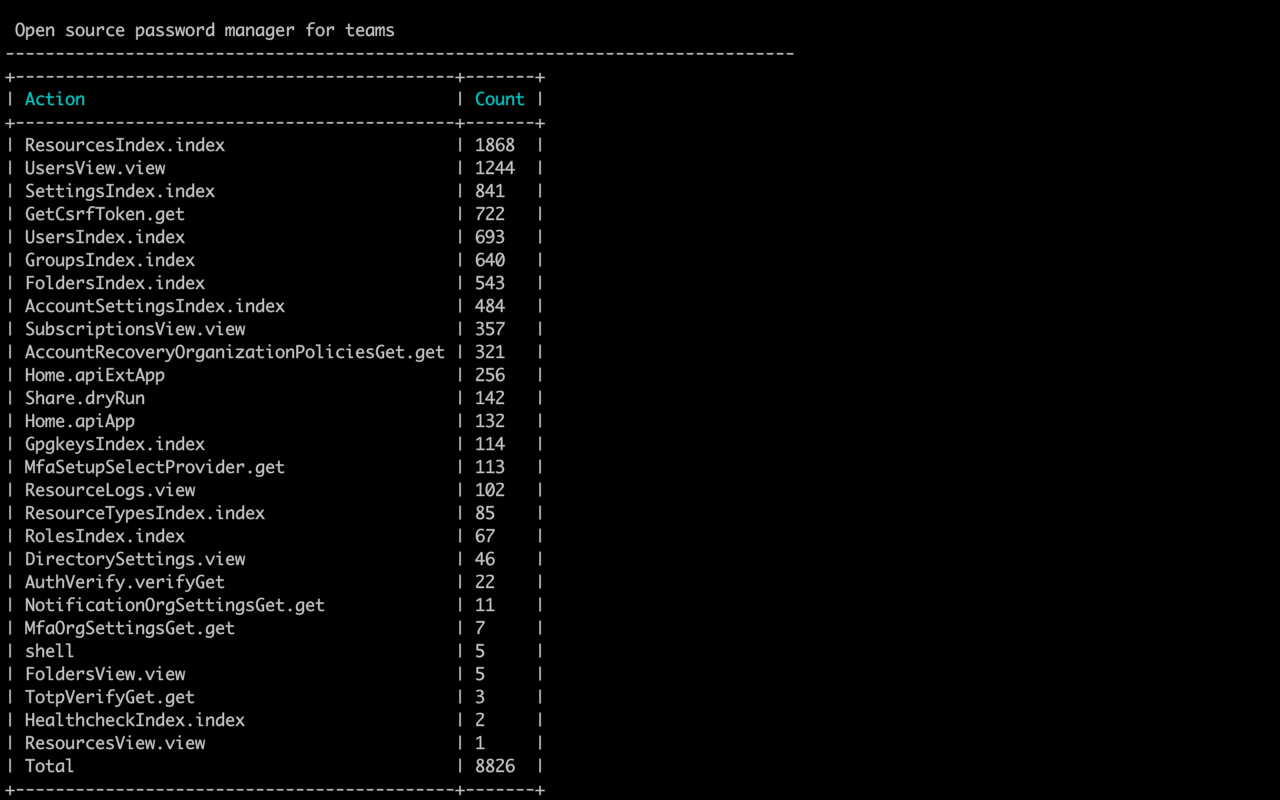
Before purging logs, always run the command with --dry-run to see how many entries would be removed:
- Package Installation
- From Source
- Docker
sudo su -s /bin/bash -c "/usr/share/php/passbolt/bin/cake passbolt action_logs_purge --dry-run -r 90" www-data
sudo su -s /bin/bash -c "/var/www/passbolt/bin/cake passbolt action_logs_purge --dry-run -r 90" www-data
docker compose exec passbolt su -s /bin/bash -c "./bin/cake passbolt action_logs_purge --dry-run -r 90" www-data
Purging Action Logs
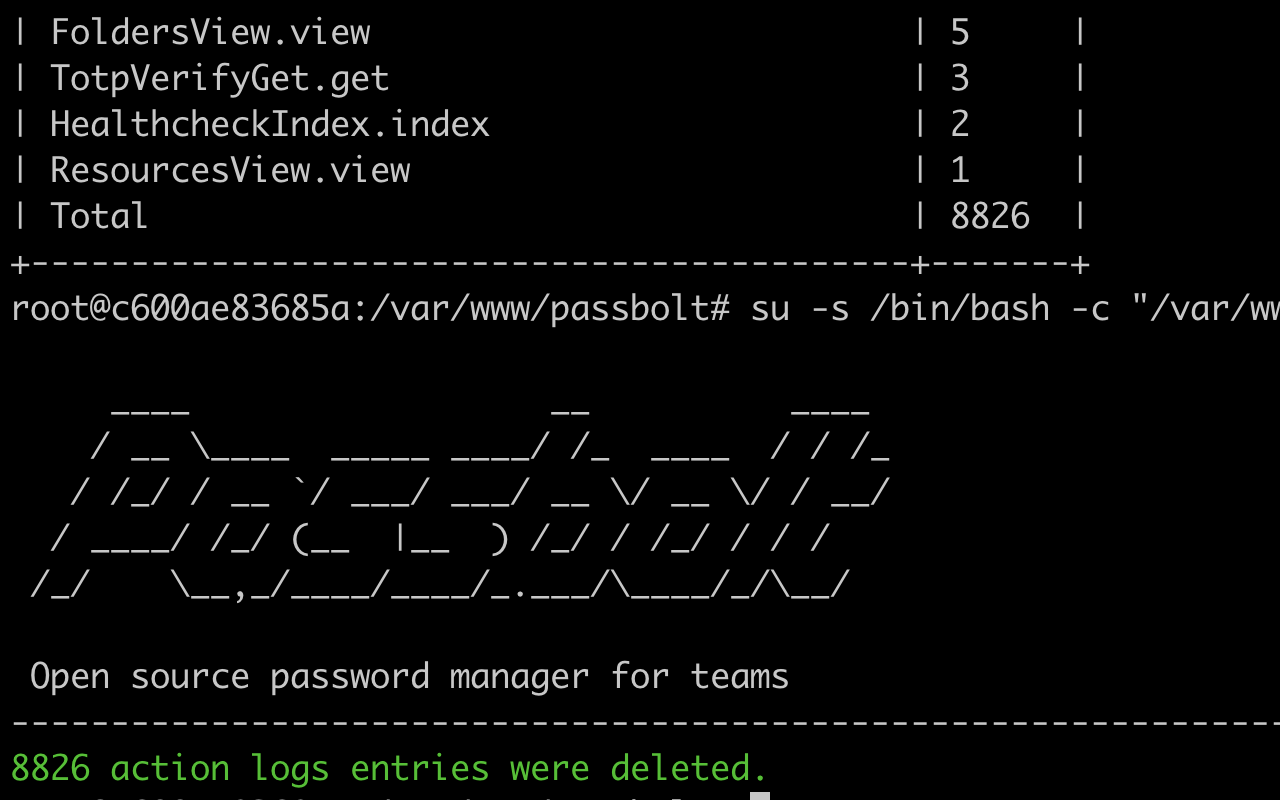
Once you've verified the dry-run output, you can proceed with the actual purge. The following example purges logs older than 90 days:
When purging large datasets, the command may consume significant memory. If you encounter Out of Memory (OOM) errors, reduce the batch size using the --limit option. For example, use -l 10000 or -l 25000 to process smaller batches. This is especially important on systems with limited RAM or when purging millions of log entries.
- Package Installation
- From Source
- Docker
sudo su -s /bin/bash -c "/usr/share/php/passbolt/bin/cake passbolt action_logs_purge -r 90" www-data
sudo su -s /bin/bash -c "/var/www/passbolt/bin/cake passbolt action_logs_purge -r 90" www-data
docker compose exec passbolt su -s /bin/bash -c "./bin/cake passbolt action_logs_purge -r 90" www-data
Additional Examples
Verbose Output
To see detailed information about logs grouped by action type:
- Package Installation
- From Source
- Docker
sudo su -s /bin/bash -c "/usr/share/php/passbolt/bin/cake passbolt action_logs_purge -r 90 -v" www-data
sudo su -s /bin/bash -c "/var/www/passbolt/bin/cake passbolt action_logs_purge -r 90 -v" www-data
docker compose exec passbolt su -s /bin/bash -c "./bin/cake passbolt action_logs_purge -r 90 -v" www-data
Custom Batch Size
For large datasets, you may want to adjust the batch size. If you have more than 100,000 logs to purge, you can either:
- Run the command multiple times (it will continue processing until all eligible logs are purged)
- Adjust the batch size using the
--limitoption:
- Package Installation
- From Source
- Docker
# Process 50,000 logs per batch (useful for systems with limited resources)
sudo su -s /bin/bash -c "/usr/share/php/passbolt/bin/cake passbolt action_logs_purge -r 90 -l 50000" www-data

# Or increase to 200,000 for faster processing on systems with sufficient resources
sudo su -s /bin/bash -c "/usr/share/php/passbolt/bin/cake passbolt action_logs_purge -r 90 -l 200000" www-data
# Process 50,000 logs per batch (useful for systems with limited resources)
sudo su -s /bin/bash -c "/var/www/passbolt/bin/cake passbolt action_logs_purge -r 90 -l 50000" www-data

# Or increase to 200,000 for faster processing on systems with sufficient resources
sudo su -s /bin/bash -c "/var/www/passbolt/bin/cake passbolt action_logs_purge -r 90 -l 200000" www-data
# Process 50,000 logs per batch (useful for systems with limited resources)
docker compose exec passbolt su -s /bin/bash -c "./bin/cake passbolt action_logs_purge -r 90 -l 50000" www-data

# Or increase to 200,000 for faster processing on systems with sufficient resources
docker compose exec passbolt su -s /bin/bash -c "./bin/cake passbolt action_logs_purge -r 90 -l 200000" www-data
The command processes logs in batches. If you have more logs to purge than the batch limit, the command will continue processing in subsequent runs until all eligible logs are removed. This makes it safe to schedule via cron for regular maintenance.
Regular Maintenance
For ongoing maintenance, consider scheduling the purge command via cron. This ensures your action_logs table remains at a manageable size. Example cron job to purge logs older than 90 days monthly:
# Add to crontab (crontab -e)
# Run on the first day of each month at 2 AM
0 2 1 * * sudo su -s /bin/bash -c "/usr/share/php/passbolt/bin/cake passbolt action_logs_purge -r 90" www-data
Adjust the retention period (-r) based on your organisation's audit and compliance requirements. Common retention periods range from 30 to 365 days depending on regulatory needs.
If you forward action logs to a SIEM, the audit history is retained outside passbolt, so the database only needs to hold what your instance itself requires. That usually allows a shorter retention period here. Confirm your SIEM is ingesting successfully before you shorten it, because purging is irreversible and does not re-emit anything. See forwarding action logs to a SIEM.